Responsible Gambling at VeryWell Casino
Gambling, in its many forms, has long been a source of entertainment for millions of people across the United Kingdom. Whether you enjoy browsing casino reviews, comparing bonus offers, or reading in-depth guides on payment methods and game strategies, the experience should always remain enjoyable, informed, and firmly within your personal boundaries. At VeryWell Casino, we believe that providing access to gambling-related content carries a genuine responsibility — one we do not take lightly.
This page exists not as a legal formality, but as a meaningful resource for anyone who visits our platform. We are committed to promoting safer gambling habits, sharing practical guidance on identifying and managing problematic behaviour, and signposting reputable UK organisations that can offer real support. Our content is designed with both casual readers and those facing genuine challenges in mind, and we encourage every visitor to take a few moments to read through the guidance below.
If at any point you feel that your relationship with gambling — or that of someone you care about — has become concerning, please do not hesitate to reach out to a professional. This page contains direct links to some of the most trusted support organisations operating across England, Scotland, Wales, and Northern Ireland. You do not need to be in crisis to seek guidance; early intervention is always the most effective approach.
Understanding What Responsible Gambling Actually Means
Responsible gambling is not simply a phrase that operators display to satisfy regulatory requirements. At its core, it refers to a set of attitudes, habits, and practical safeguards that allow individuals to engage with gambling entertainment without it causing harm — financial, emotional, or social. The UK Gambling Commission sets out clear expectations for both operators and consumers, emphasising that gambling should always be treated as a leisure activity with a known cost, never as a method for generating income or escaping personal difficulties.
The principle of responsible gambling rests on a simple but powerful idea: you are in control. You decide how much time you spend, how much money you risk, and when to stop. When those boundaries begin to blur — when sessions run longer than intended, when money earmarked for bills ends up at the casino, or when gambling becomes a primary emotional outlet — the activity has crossed from entertainment into something that demands attention. Recognising this shift, and knowing where to turn when it happens, is the foundation of everything we advocate on this page.
It is also important to acknowledge that responsible gambling looks different for different people. For some, it means setting a strict monthly budget and never exceeding it. For others, it involves using self-exclusion tools during periods of stress or financial difficulty. There is no single correct approach, but there are consistent principles — honesty with yourself, awareness of your habits, and willingness to seek help when needed — that underpin every effective safer gambling strategy.
Recognising the Warning Signs Before They Become a Crisis
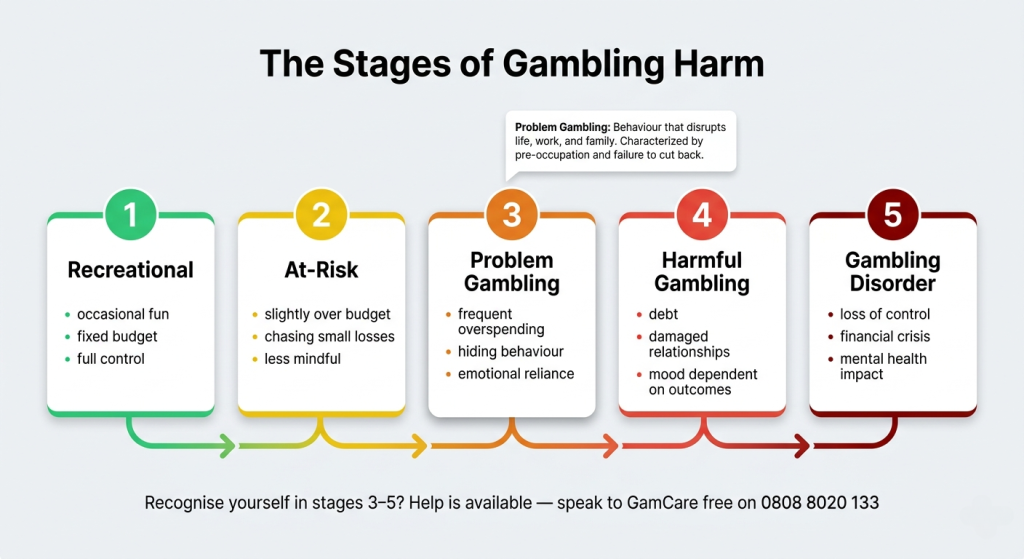
Problem gambling rarely announces itself dramatically. More often, it develops gradually, through small shifts in behaviour that can be difficult to notice from the inside. Awareness of these early indicators is one of the most valuable tools available to any gambler, and to the people around them.
The following warning signs may indicate that gambling has moved beyond healthy entertainment:
- Spending more money than originally planned during a single session or over a week
- Returning to gambling shortly after a loss in an attempt to recover funds (“chasing losses”)
- Feeling irritable, anxious, or restless when not gambling or when attempting to stop
- Lying to friends, family members, or colleagues about the frequency or cost of gambling activity
- Using gambling as a way to escape from stress, depression, loneliness, or boredom
- Borrowing money, selling possessions, or neglecting bills in order to fund gambling
- Neglecting work, family responsibilities, or personal health due to time spent gambling
- Failed attempts to cut back or stop gambling despite genuine effort
- Feeling a persistent preoccupation with gambling — reliving past wins or planning next sessions
- Experiencing guilt or shame after gambling, yet continuing regardless
If you recognise several of these patterns in yourself, or in someone close to you, it is worth pausing and considering whether professional support might be appropriate. The presence of two or three warning signs does not make someone an “addict” — but it does suggest that a more mindful approach to gambling is needed. Acting early, before financial or relationship damage becomes severe, is always the wisest course of action.
The Emotional Toll of Gambling Harm
Public conversations about gambling harm tend to focus almost exclusively on financial consequences, but the emotional and psychological impact can be equally — if not more — devastating. Shame, secrecy, and isolation are common companions of problem gambling, and they often prevent individuals from seeking help long after they recognise that something is wrong. Many people feel deeply embarrassed by their situation, believing that they should be able to simply “stop” through willpower alone.
In reality, problematic gambling can involve genuine changes in brain chemistry related to reward, dopamine, and impulse control — mechanisms that are not so different from those involved in other recognised addictions. Feeling trapped, hopeless, or deeply ashamed is a natural response to a situation that has spiralled beyond your control, but those feelings do not reflect the truth of who you are or your capacity for recovery.
Anxiety and depression frequently co-occur with problem gambling. In some cases, gambling begins as a way to manage difficult emotions, only to amplify those same emotions over time. Relationships suffer, self-esteem deteriorates, and the sense of living a double life — presenting one face to the outside world while privately struggling — can become exhausting and isolating. Recognising this emotional dimension is not a sign of weakness; it is an essential first step in understanding the full scope of what needs to change.
If you are experiencing suicidal thoughts or feelings of severe hopelessness, please contact Samaritans immediately, available 24 hours a day, seven days a week by calling 116 123 free of charge. You do not need to be in immediate danger to reach out — they are there to listen at any stage of distress.
Financial Consequences and Taking Back Control of Your Budget
The financial consequences of gambling harm are often the most visible and measurable aspect of the problem, even though they rarely capture the full picture of what someone is experiencing. Debt accumulates quickly when gambling spending is not kept within a defined budget, and the psychological pressure of financial difficulty can, paradoxically, increase the urge to gamble in search of a quick resolution — creating a cycle that is genuinely difficult to break without external support.
Taking practical steps to regain financial control is one of the most important things you can do, whether you are currently experiencing difficulties or simply want to ensure they never arise. Consider implementing the following measures:
- Set a gambling budget and treat it as non-negotiable. Decide in advance exactly how much money you are willing to spend on gambling entertainment each week or month, and commit to stopping once that amount is reached — regardless of wins or losses.
- Use a dedicated account or prepaid card. Loading a fixed amount onto a separate account or prepaid card prevents accidental overspending and provides a clear visual representation of what remains.
- Remove financial products that enable impulsive gambling. This might mean deleting saved payment details from gambling sites, or speaking to your bank about implementing transaction blocks (see our dedicated section on this below).
- Monitor your statements regularly. Reviewing your bank or credit card statements at least once a week makes it harder to underestimate how much you are spending.
- Seek free debt advice if necessary. Organisations such as StepChange and Citizens Advice offer confidential, non-judgemental guidance to anyone struggling with debt — including debt accrued through gambling.
Understanding the true cost of gambling also means recognising that the mathematical odds favour the house in almost every form of casino gaming. No system, strategy, or “lucky streak” changes this fundamental fact. Approaching gambling with realistic expectations — that you will likely spend more than you win over time — is an honest starting point for sustainable financial management.
Practical Strategies for Safer and More Enjoyable Gambling
Safer gambling is not about removing all enjoyment from the experience. On the contrary, putting sensible boundaries in place can actually make gambling more pleasurable, because you engage with it on your own terms rather than feeling driven by compulsion or chasing elusive wins. The following practical strategies are widely recommended by professionals working in gambling harm prevention:
- Always gamble with money you can afford to lose. If losing your gambling budget would affect your ability to pay rent, utilities, or food, that money should not be allocated to gambling.
- Set time limits before you start. Decide in advance how long you will spend on a given session and use a timer or alarm to enforce it.
- Take regular breaks. Leaving the screen or stepping away from the game disrupts the hypnotic rhythm that can lead to extended, unplanned sessions.
- Never gamble when you are emotionally vulnerable. Grief, stress, loneliness, intoxication, and fatigue all impair judgement and increase the likelihood of impulsive decisions.
- Balance gambling with other leisure activities. A healthy relationship with gambling typically exists alongside a rich variety of hobbies, social activities, and personal interests — not in place of them.
- Keep a gambling diary. Recording how much you spend, how long you play, and how you feel before and after each session can reveal patterns that are not immediately obvious.
- Avoid chasing losses. The decision to “win it back” with one more deposit is one of the most common and most costly errors in gambling behaviour. If you have reached your limit, the session is over.
These are not rules imposed from outside — they are tools you can use to stay in control of an activity that is, at its best, genuinely entertaining. Applying even a few of them consistently can make a significant difference to both your finances and your peace of mind.
Gambling Myths That Can Lead You Astray
Misinformation about how gambling works is surprisingly widespread, and some of the most persistent myths are the ones most likely to cause financial harm. Understanding the facts behind these misconceptions is an important part of maintaining a healthy relationship with gambling content and activity.
| The Myth | The Reality |
|---|---|
| A machine or game that hasn’t paid out for a while is “due” a win | Each spin or hand is an independent random event. Past results have no influence on future outcomes. |
| Skilled gambling strategies can overcome the house edge | While strategy can reduce the house edge in games like blackjack, it cannot eliminate it. The operator always maintains a mathematical advantage over time. |
| Gambling is a reliable way to make money | The Return to Player (RTP) figures for all casino games are set below 100%, meaning players collectively lose more than they win in the long run. |
| Near-misses mean a big win is coming | Near-misses are a standard feature of slot design that create the psychological illusion of almost-winning. They hold no predictive value whatsoever. |
| Problem gambling only affects people with weak willpower | Gambling disorder is a recognised condition that can affect anyone, regardless of intelligence, personal strength, or social background. |
| You can only have a gambling problem if you gamble every day | Frequency is not the defining factor. Gambling becomes problematic when it causes harm — financially, emotionally, or socially — regardless of how often it occurs. |
Self-Exclusion: A Powerful Tool for Regaining Control
Self-exclusion is a formal process through which a person voluntarily restricts their own access to gambling. It is one of the most effective practical interventions available to anyone who feels they are losing control of their gambling behaviour, and it should be considered without hesitation or embarrassment. Choosing to self-exclude is an act of self-awareness and personal strength, not an admission of failure.
In the UK, the most widely used self-exclusion scheme is GAMSTOP, a free national service that allows you to register once and have your exclusion applied across all online gambling operators licensed by the UK Gambling Commission. You can choose an exclusion period of six months, one year, or five years. Once registered, you cannot reverse the exclusion during the chosen period — which is by design, helping to protect you during moments when the urge to gamble might feel overwhelming.
It is important to understand that GAMSTOP applies only to UKGC-licensed sites. If you are concerned about accessing unlicensed offshore gambling sites, additional blocking tools (described in the following section) can provide a more comprehensive barrier. Self-exclusion at the individual casino or platform level is also available and can be arranged directly through the operator’s responsible gambling tools.
Blocking Software: An Extra Layer of Protection
For many people, self-exclusion alone does not feel sufficient — particularly during the early stages of recovery, when the temptation to circumvent restrictions can be strong. Gambling blocking software provides a robust technical barrier that makes accessing gambling websites considerably more difficult, across all devices connected to a given account or network.
The following tools are widely used and recommended within the UK safer gambling community:
- Gamban — A comprehensive blocking app that prevents access to thousands of gambling websites and apps across all your devices. It is available at low cost and works on smartphones, tablets, laptops, and desktop computers.
- BetBlocker — A free tool that blocks access to over 90,000 gambling websites. It can be set up on up to five devices and allows you to choose a blocking period of between 24 hours and five years.
- GamBlock — One of the most established blocking tools, designed to be extremely difficult to remove or bypass. It offers a high level of restriction for those who need the most robust protection.
- NetNanny — Primarily designed as a parental control tool, NetNanny can be configured to block gambling content across shared devices and is particularly useful for households where multiple people need protection.
Using a combination of GAMSTOP and one or more of the above blocking tools is widely considered best practice for anyone who is serious about maintaining a gambling-free period. We encourage anyone who is struggling to explore these options without delay.
Blocking Gambling Transactions Through Your UK Bank
One practical step that many people overlook is the ability to block gambling transactions directly through their bank or credit card provider. Most major UK banks and financial institutions now offer this facility, allowing customers to prevent their cards from being used for gambling-related payments. This feature is usually available through the bank’s mobile app or online banking portal, and in many cases can be activated and deactivated within seconds.
The following major UK banks currently offer gambling transaction blocks:
- Barclays — Gambling blocks available through the Barclays mobile app
- Lloyds Banking Group (including Lloyds, Halifax, and Bank of Scotland) — Spending controls accessible via mobile banking
- NatWest and Royal Bank of Scotland — Card controls available in the app
- HSBC — Gambling restrictions available through the HSBC UK app
- Monzo and Starling Bank — Both challenger banks offer particularly granular spending controls, including real-time gambling blocks
- Nationwide Building Society — Gambling blocks available via internet banking and the app
It is worth noting that blocking gambling transactions at the bank level does not prevent you from withdrawing cash to gamble elsewhere, so this measure is most effective when used alongside other tools such as GAMSTOP and blocking software. However, as part of a broader strategy, it can remove the ease of impulse spending that many people identify as a key trigger for problematic sessions.
Protecting Children and Vulnerable Individuals
Our platform contains detailed reviews and guides relating to online gambling products, and we have a clear obligation to ensure that this content does not reach individuals who should not be accessing it. The minimum legal gambling age in the United Kingdom is 18, and we are firmly committed to supporting every measure available to keep minors safe from exposure to gambling-related material and activity.
If you share a device with children or young people, we strongly recommend enabling parental controls at the device, browser, and network level. Several of the blocking tools mentioned above — including NetNanny — are specifically designed to filter inappropriate content on shared family devices. Speaking openly with young people about the nature of gambling, including its risks and the way it is marketed, is also an important protective factor.
Vulnerable adults — including those experiencing mental health difficulties, bereavement, financial crisis, or other significant life stressors — may also be at heightened risk of developing problematic gambling habits. If you are in a position of care for someone in these circumstances, it may be worth having a gentle and non-judgemental conversation about their gambling activity. The organisations listed throughout this page can also provide guidance and support specifically aimed at friends and family members.
Anyone under the age of 18 who discovers this page should not be gambling, and we would encourage them to speak with a trusted adult. The BigDeal website is a UK-specific resource designed for young people, offering honest and accessible information about gambling risks in language aimed at teenagers and young adults.
Emotional and Financial Support for Family Members
Living alongside someone affected by gambling disorder is an experience that can be profoundly distressing. Family members and close friends often describe feelings of betrayal, confusion, helplessness, and anger — sometimes alongside a persistent guilt that they should somehow be able to fix the problem. It is important to be clear: problem gambling is not caused by the people around the gambler, and it is not within the power of loved ones alone to resolve it.
What family members can do is seek their own support, set boundaries that protect their financial and emotional wellbeing, and where appropriate, encourage the person they are concerned about to access professional help. This is not always easy, particularly when the person affected is unwilling to acknowledge the problem. There are, however, organisations in the UK specifically focused on supporting those affected by someone else’s gambling:
- GamCare — Offers a dedicated support line, live chat, and counselling services for both gamblers and those close to them. Their National Gambling Helpline is free to call on 0808 8020 133, available seven days a week.
- Gamblers Anonymous UK — Runs Gam-Anon groups specifically for the families and friends of people with gambling problems, providing peer support from others who have been through similar experiences.
- Gambling Therapy — Provides free online support for both gamblers and those affected by a loved one’s gambling, including forums, live chat, and self-help resources.
If you are supporting someone through recovery, it is equally important to take care of your own mental health. Seeking individual counselling, joining a peer support group, or simply confiding in a trusted friend can make a significant difference to your own resilience and capacity to help.
Where to Find Professional Help in the UK
There is a wide range of professional support available to people in the UK who are experiencing difficulties with gambling. Services range from free self-help resources and helplines through to structured counselling, residential treatment, and specialised NHS clinics. The right level of support will depend on the severity of the difficulties and personal circumstances, but the most important step is simply making contact and having an initial conversation.
The following organisations offer professional gambling support services in the UK:
- BeGambleAware — The UK’s leading safer gambling charity, offering a free national helpline (0808 8020 133), online chat, and a comprehensive directory of treatment services across the country. Their website also contains extensive self-assessment tools and educational resources.
- Gordon Moody — Provides residential rehabilitation programmes and online therapy for people with severe gambling addictions. Their services are available free of charge to those who meet the criteria, and they also operate therapeutic communities for longer-term recovery support.
- National Problem Gambling Clinic — The UK’s only NHS outpatient clinic dedicated exclusively to treating gambling disorder. Based in London, the clinic offers cognitive behavioural therapy (CBT) and other evidence-based interventions, accessible via GP referral or self-referral.
- NHS Northern Gambling Service — An NHS-funded service offering specialist assessment, individual therapy, group therapy, and family support for people in the north of England affected by gambling harm.
- NHS Southern Gambling Service — Provides similar specialist NHS treatment to people in the south of England, offering both face-to-face and remote therapy options.
- West Midlands Gambling Harm Clinic — Offers NHS-funded gambling treatment including individual therapy, group sessions, and peer mentoring for people across the West Midlands region.
Do not allow concerns about cost to prevent you from seeking help. The majority of specialist gambling treatment services in the UK are available free of charge through NHS commissioning or charitable funding. Your GP is also an excellent first point of contact and can discuss your options, make referrals, and provide support for any related mental health concerns.
About This Website: Our Role and Our Responsibilities
We want to be completely transparent about the nature of this platform and the role it plays in the broader gambling ecosystem. Our website is an independent affiliate and informational resource. We do not operate a casino, accept deposits, or hold any form of gambling licence. Our primary function is to publish reviews, guides, and comparisons relating to licensed online casinos, bonuses, slot games, and payment methods, to help UK players make better-informed choices about where and how they choose to gamble.
Some of the content on our platform contains affiliate links. This means that if you visit a casino through a link on our site and subsequently create an account or make a deposit, we may receive a commission from the operator concerned. This is a standard commercial arrangement within the gambling affiliate industry, and it does not affect the independence of our editorial opinions or the accuracy of our reviews. Our Terms & Conditions provide full details of how our affiliate relationships work and what this means for you as a user.
We do not encourage you to gamble, nor do we recommend any specific casino unconditionally. Our reviews are designed to present factual information about bonuses, licensing, game selection, and responsible gambling features so that you can make a genuinely informed decision. We encourage all visitors to read our Privacy Policy to understand how your data is handled, and our FAQ section for answers to common questions about our platform and content. You can also learn more about who we are and how we operate on our About Us page.
Frequently Asked Questions About Responsible Gambling
How do I know if I have a gambling problem?
There is no single threshold that defines a gambling problem. A useful starting point is to ask yourself honestly: is gambling costing me more than I can afford, emotionally or financially? If you are regularly exceeding your intended spending limits, lying to people about your gambling, chasing losses, or feeling unable to stop despite wanting to, these are meaningful signs that the activity has become harmful. BeGambleAware offers a free online self-assessment tool that can help you evaluate your own situation.
What is GAMSTOP and how quickly does it take effect?
GAMSTOP is the UK’s national online self-exclusion scheme. Once you register with a minimum exclusion period of six months, your details are shared across all UKGC-licensed online gambling platforms within 24 hours. You will then be blocked from creating new accounts or accessing existing ones on any participating site during your chosen exclusion period.
Can I reverse a self-exclusion if I change my mind?
In the case of GAMSTOP, you cannot reverse a self-exclusion before the minimum period has expired. This is a deliberate feature of the scheme, designed to protect you during moments when the urge to return to gambling may be at its strongest. After your exclusion period has ended, there is a cooling-off process before access can be restored.
Is gambling blocking software difficult to install?
Most modern blocking tools are designed to be straightforward to install, and many offer step-by-step guidance or customer support to help with the process. Tools like BetBlocker are free and can typically be set up within a few minutes. The key is choosing software that is genuinely difficult to remove impulsively — some tools require contact with a third party or a waiting period before they can be uninstalled.
What should I do if a family member refuses to acknowledge their gambling problem?
This is an extremely common and genuinely difficult situation. You cannot force someone to acknowledge or address a gambling problem, but you can protect your own financial and emotional wellbeing, seek support for yourself through organisations like GamCare’s family support services or Gamblers Anonymous Gam-Anon groups, and make it known that help is available whenever they are ready. Sometimes, simply leaving information about support services somewhere accessible can plant a seed that leads to change in time.
Are the gambling treatment services in the UK free?
Yes — the vast majority of specialist gambling treatment available in the UK is provided free of charge through NHS-funded services or gambling support charities. This includes helplines, online counselling, group therapy, and residential rehabilitation programmes. Cost should never be a reason to delay seeking help.
Does this website encourage gambling?
No. Our platform provides informational reviews, guides, and comparisons relating to licensed gambling products in the UK. We aim to help readers make informed decisions, but we do not encourage anyone to gamble, and we actively promote the responsible gambling principles outlined throughout this page. If you are experiencing difficulties, we strongly encourage you to use the resources linked here rather than accessing gambling content.
Get in Touch
If you have questions about responsible gambling, concerns about the content on our platform, or would like to discuss our safer gambling approach, please do not hesitate to contact us. Our team takes all responsible gambling enquiries seriously and will respond promptly.
You can reach us at [email protected] or visit our dedicated Contact page for additional options. We are also happy to receive feedback on this page and any suggestions for improving the responsible gambling resources we provide.
For urgent matters relating to gambling harm, please contact GamCare’s National Gambling Helpline: 0808 8020 133 (free, 7 days a week, 8am–midnight). For emotional crises, Samaritans are available 24/7 on 116 123.